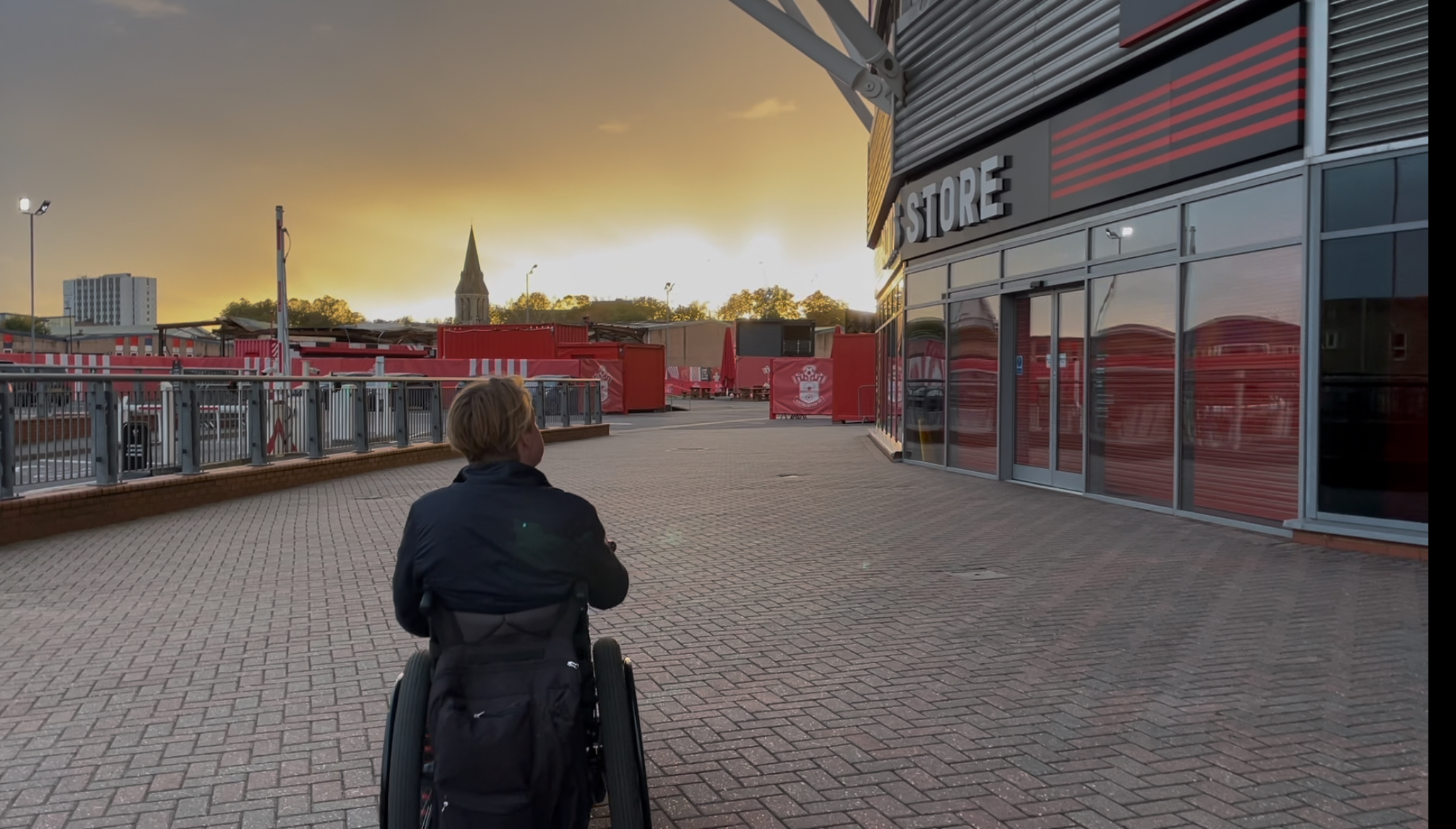
FOR BBC 5live’s Andy Stevenson, doing his day job is a matter of overcoming barriers that simply don’t exist for able bodied journalists.
At a ground of an EFL League 2 club, he was left stranded with no support or consideration for his specific needs.
“It was just a complete nightmare. It was a disaster. There weren’t even any desks — just 20 to 30 seats allocated to the press. Once everyone was in position, there was no way for me to get to my seat. I can’t clamber over seats like other people do — I just couldn’t do it. I had nowhere to put my notes or my equipment. It was utterly ridiculous. I had to hold my phone on my arm and use my mouth to type my notes.” Only I would have noticed it, but you could hear the pause where I had to flick the screen with my mouth.”
Stevenson was born without arms and a left leg or in his own words, ‘without a full complement of limbs’. He’s worked for the likes of the BBC, and Channel 4 covering football for over 15 years, yet still a stigma remains around disabled sports journalists, evidenced by the lack of accessible press facilities within grounds across the country.
“Ultimately, the truth is they are not expecting disabled people to be in those press boxes,” he said.
“There is not an expectation that somebody in a wheelchair or somebody with a prosthetic leg is going to be a football reporter.”
The issue and the importance of context.
To fully understand this problem, you must grasp the scale of the issue and the extent to which it affects disabled journalists in this country.
Paul McCarthy, head of the Football Writers Association, is clear that most facilities are not fit for purpose:
“Even able-bodied reporters sometimes find press boxes difficult,” McCarthy said. “Lots of stairs and very cramped conditions.”
However, like with any problem for minority groups context is important.
“A lot of stadia were built in the early part of the twentieth century, when accessibility simply wasn’t considered,” he continued.
Stevenson himself admitted that he’s willing to give leeway to those who deserve it:
“Some football grounds are like London Underground stations — they’ve been there for 100 years, and accessibility wasn’t considered when they were built. I would cut a little bit of slack to some of those grounds — but only a little.”
Furthermore, given the variety and spectrum across the English football pyramid, it’s not only age isn’t the only factor restricting clubs’ ability to adapt.
Brentford FC: “The gold standard”.
As we look to a long-term solution, Brentford FC is an example of how things should done
“Brentford’s new stadium is the absolute gold standard for accessibility. It was brilliant for everyone, but really, really brilliant for me personally. They’ve taken accessibility seriously, but in a friendly, open way — not a patronising way. They ask you what you want, what you need. Nothing’s too much trouble. It doesn’t make you feel ‘disabled’ or like you’re a burden.” Stevenson told me
Likewise, McCarthy listed the Bees as an example of having a modern ground which set the standard for accessibility, alongside Tottenham and Everton.
So, to further my investigations, I thought I’d get in contact with them at see if I could go down and experience it for myself. Within a few days I had organised a visit to the GTECH, their responsiveness and willingness to help, was a sign of things to come, which is more than can be said for the other 91 clubs in the top four divisions.
It was clear to me that not only had they prioritised accessibility but the entire process for accessibility for all is a clear and well thought out at Brentford. There is not one area that I would describe as inaccessible, even the commentary gantry. Similarly, looking beyond the ramps, or lifts, it was the attitude, the selflessness and awareness of the entire club that struck me.
Amelia Archer, the club’s media executive, told me about some of the provisions the club has made with access in mind:
“All of our journalists are able to get to every single place that the press have access to. The press box, the media room, the press conference room, the tunnel area, pitch side — all of it is accessible.”
“Everything is flat,” Archer explains. “If journalists want to go upstairs, there’s a lift straight up and across.”
Archer confirms that disabled journalists, including Stevenson, regularly work from the stadium without additional barriers.
“Andy often needs to go downstairs for post-match interviews,” she said.
“He can get in the lift, come down with his assistant, and get where he needs to be easily and quickly.”
Changing the perspective
I was left with one key thought after my visit to the GTECH:
Brentford have not only thought about accessibility everyone including journalists, but it has been at the heart of every logistical decision made by the club.
This issue is not just about ensuring all press facilities are accessible but changing people’s perspectives of disabled sports journalists as a whole.
Stevenson said: “Ultimately, the truth is they are not expecting disabled people to be in those press boxes. There is not an expectation that somebody in a wheelchair or somebody with a prosthetic leg or somebody who’s blind is going to be a football reporter. It’s a vicious circle — a lot of people would be put off trying to be a football reporter because of the poor accessibility. We kind of have to be the driving force behind getting things changed.”
“If there were five disabled reporters working week in, week out, clubs would have to respond,” he said.
“If there’s a need, which there is, clubs have to respond,” McCarthy concurs.