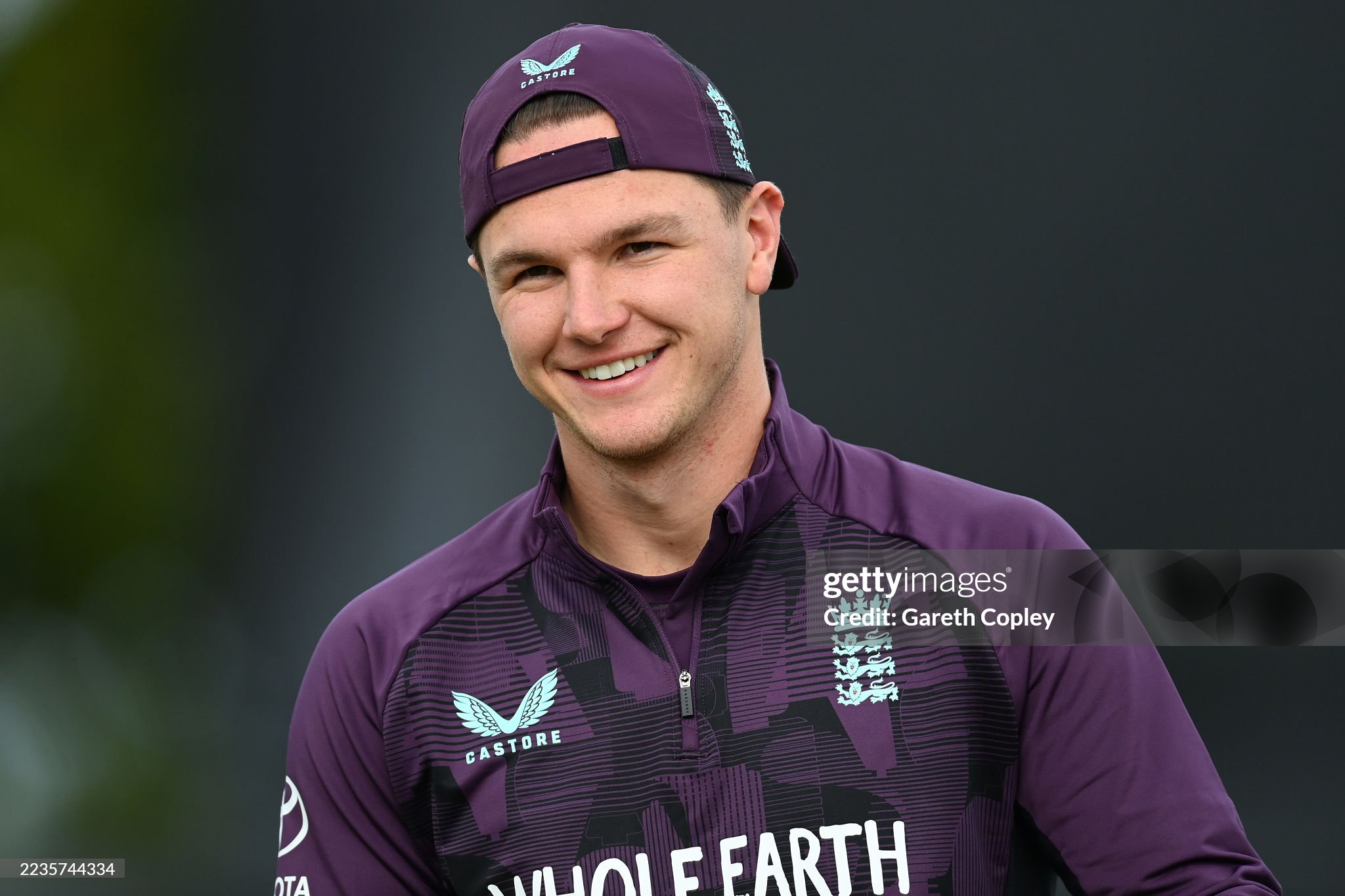
THERE is a moment that every fast bowler fears, and for Sonny Baker it came in the first over of the first game, before the tournament had even officially begun.
“I picked up a stress fracture in my back playing the first over of the first warm-up game and I knew I was in trouble,” explained Baker, on a drizzly and cold March morning at the Utilita Bowl.
The injury came just before the 2022 ICC Under-19 World Cup in the West Indies, a tournament in which England lost the final to India. Baker had been named in the squad alongside Rehan Ahmed and Jacob Bethell, both of whom went on to play Test cricket in the years that followed.
“I had back-to-back stress fractures in those few years, so I just watched the lads on TV get all the way to the final and then get turned over by India, which was tough,” admitted Baker.
The injury came at 18, but the speed had been there long before. Baker grew up in Devon, playing his club cricket for Torquay and progressing through the pathway before being brought into Somerset’s academy.
“I’d always had pace but my wrist position was so far inside the ball that I’d either bowl a massive inswinger or bowl a leg cutter and lose loads of pace,” said Baker.
Somerset had been tracking Baker since the 2018 Bunbury Festival, which was significant as it is the ECB’s annual under-15 showcase, where the best young players in the country are brought together.
His performances there had already marked him out as a bowler of serious pace, but it was his work with Andrew Griffiths, Somerset’s pathway bowling coach, that helped turn it from a raw and exciting attribute into something more controlled and repeatable.
“It was at 16 and 17 years of age when I really put my foot down as I did an extensive amount of work with Andrew Griffiths on my wrist position.”
“He tried to get me to bowl off-spin with my wrist so I could understand what it was like to be behind the ball, making a massive difference to my pace immediately.”
“Since then, I have never looked back and I still credit him to this day as the biggest part in my development of being able to swing the ball both ways.”
Despite all his good work, Baker was still without a contract or academy place, there was no clear route forward, and the uncertainty coincided with his first serious injury.
“I got injured when I was 17 and around that period of time, I was making UCAS applications and thinking about what I was going to do? I’d more or less accepted that cricket wasn’t really going to happen but looking back at it, that’s a mental thing to do at that age,” recalls Baker.
At that point, Baker was caught between Devon, which sits outside the first-class structure as a National County, and Somerset, a first-class county with a pathway that feeds directly into the professional game.
“Devon were forming their academy and Somerset had just disbanded their PSPP so I fell in the gap. Devon thought I was with Somerset and Somerset thought I was with Devon,” explained Baker.
With his future uncertain, Baker had drifted out of the system at a stage when most players are about to break through, though an unexpected phone call was about to change that for him.
“Someone got injured at the England under 19’s trial so Steve Snell, the academy director at the time, called my dad and asked if there was any way to get to Loughborough the following evening,” said Baker, smiling.
A smile which widened as he recalled that, “next thing you know I am opening the bowling for the north of England, even though I was the most southern player at the trail.”
The call and ensuing trial marked the start of a rapid ascent for Baker, as he found his way into professional cricket, bagged a ‘Hundred’ contract and was representing his country, all in the space of 18 months.
“I got picked for the Somerset Academy off the back of that, then played the whole Royal London One Day Cup and ended as the top wicket taker for Somerset in that tournament.”
His sharp ascent then came to a sudden halt, as another back injury during the 2022 season disrupted his progress, forcing Baker to go back into rehab and start rebuilding again.
“I’d been injured and wasn’t really sure what I was doing, so Somerset told me to go away for the winter, which I misinterpreted and basically ended up paying for my flights to go to Australia.”
More recently, Baker has worked with UK-based fast-bowling coach Shahbaz Choudhry, who runs a programme called SpeedCamp and has been involved with a number of elite seamers, including England internationals Jofra Archer, Tymal Mills and Saqib Mahmood.
“(Shah)baz has been awesome, I learnt so much from him, especially nutritionally, lifestyle wise and with all my little one percenters like bone broth and green juices.”
Those “one percenters” reflect the increasing emphasis on marginal gains in fast bowling, particularly around recovery, nutrition and workload management, all of which are critical for players like Baker who have dealt with stress injuries.
A winter in Australia, then a move to Hampshire in 2025 gave Baker a fresh start that he took with both hands, making an immediate impact by producing performances across formats.
That form carried into The Hundred, where he starred for the Manchester Originals, including taking a hattrick against the Northern Superchargers, while consistently bowling above 90mph.
Soon enough, Baker had earnt himself an England call-up, but his introduction to international cricket proved far more unforgiving. On ODI debut against South Africa at Headingly, Baker was targeted by Aiden Markram and finished with figures of 0 for 76 from seven overs.
“I wouldn’t wish that debut on many people but I don’t think I bowled badly, as (South Africa) were chasing 131, I was up against a good player, who went after a young seamer on debut.”
That experience, however, has done little to alter Baker’s outlook as he explains that, “one of my greatest strength is just taking things objectively, as the reality is that you’re going to have bad games and that’s okay.”
“There’s games where I’ve bowled badly and got loads of wickets but also games where I bowled really well and ended up going at fours without any wickets. That’s just the way cricket goes as there’s ups and downs which you have to take in your stride and move on,” said Baker.
That mindset is underpinned by a level of preparation that is key to his development, with Baker building a detailed system of research in his trusty notebooks.
“I still have the same notebook I used to have, but I’ve now filled up three or four. I use it for things like match prep, analysis on the batters, personal learnings from training sessions, predicted workloads and I’ve even got an Excel document for it on my laptop.”
It reflects a wider approach shaped by the time he spent off the field as during long injury layoffs, Baker studied batters, ground dimensions and bowling plans in extensive detail.
“Everyone’s a student in the game and one of the biggest things that I try and live by is that you can get very little experience from a lot of exposure, or you can get a lot of experience from very little exposure, the only difference is in your application.”
For Baker, those ideas are not just words but principles he lives by because as “dad says there’s a lot of guys in pubs that used to be the best centre half in South West England and have great excuses for why they didn’t make it. Was it really your knee, or was it the fact that you’re overweight and not trying in training?”
“I don’t want to leave any stones unturned and I don’t want to look back on my career and end up wishing I’d done something differently here or there. That would be much tougher for me to cope with than knowing that I gave it absolutely everything.”