In 490 BC, some 10,000 Athenian hoplite soldiers faced between 25,000 and 40,000 Persian invaders under the command of Xerxes I in the Bay of Marathon.
In such a lopsided battle, a soldier’s victory is simply not to die. On this occasion, that premise was realised through the Athenians’ courage and their desire to stay alive. They ran towards the invaders to avoid their arrows as they overtook them.
Following their victory, the Athenians began to run once more—this time heading back toward Athens, intending to prevent the Persians from landing in the Polis.
Victory was delayed, and to prevent the women of Athens from sacrificing their children to avoid becoming slaves to the Persians, General Miltiades sent a messenger who, having just been in battle, had to cover a distance of 40-42 km to deliver the news.
The messenger, named Pheidippides, not only carried out the order but put all his strength into reaching his destination as quickly as possible. Exhaustion caused him to collapse, and with his last breath, he managed to say: “Nike” (the Greek goddess of victory).
A few weeks ago, upon my arrival in Spain, I accepted an invitation from the women’s supporters’ club “Las Colchoneras”, extended through the group “Los 50”, where I have good friends, They have lent their experience, expertise and contacts so that, over the last four years, the Atlético de Madrid women’s team supporters’ club has created and established a leading platform to recognise women’s contribution to sport from a Rojiblanca perspective – one that is inclusive and deeply emotional.
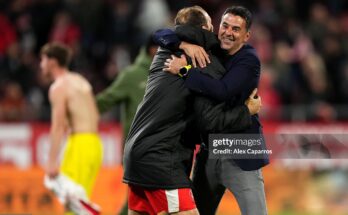
Although the setting was not Marathon Bay, but instead the auditorium of the Estadio Metropolitano, and the event was not a battle but a tribute, the spirit was similar. This event celebrated the ‘warriors’ who, during the 1970s, flew the flag for Atlético de Madrid in the handball section, and also marked the 25th anniversary of the founding of the club’s current women’s football team.
Thirty years on from the first time Margarita Luengo threw carnations – red and white flowers that were ever-present even during the closed-door matches held at the Vicente Calderón and the Metropolitano due to the Covid-19 pandemic – in the south-end corner.
Lola Romero received the award for leadership and the impact of women in sport. The award was named after Almudena Grandes, the 2018 National Narrative Prize winner and recipient of the Gold Medal for Fine Arts. Almudena, a member of “Los 50” until her death in May 2021, inspired many.
Among the awards presented was one that also recognised achievement, leadership and the impact of women in sport; for me – and I believe for almost all 200 attendees at the event – the most moving was the Rubén Caravaca Award, named after the Spanish social activist, writer and cultural manager who specialises in communication, cooperation, production and cultural mentoring.
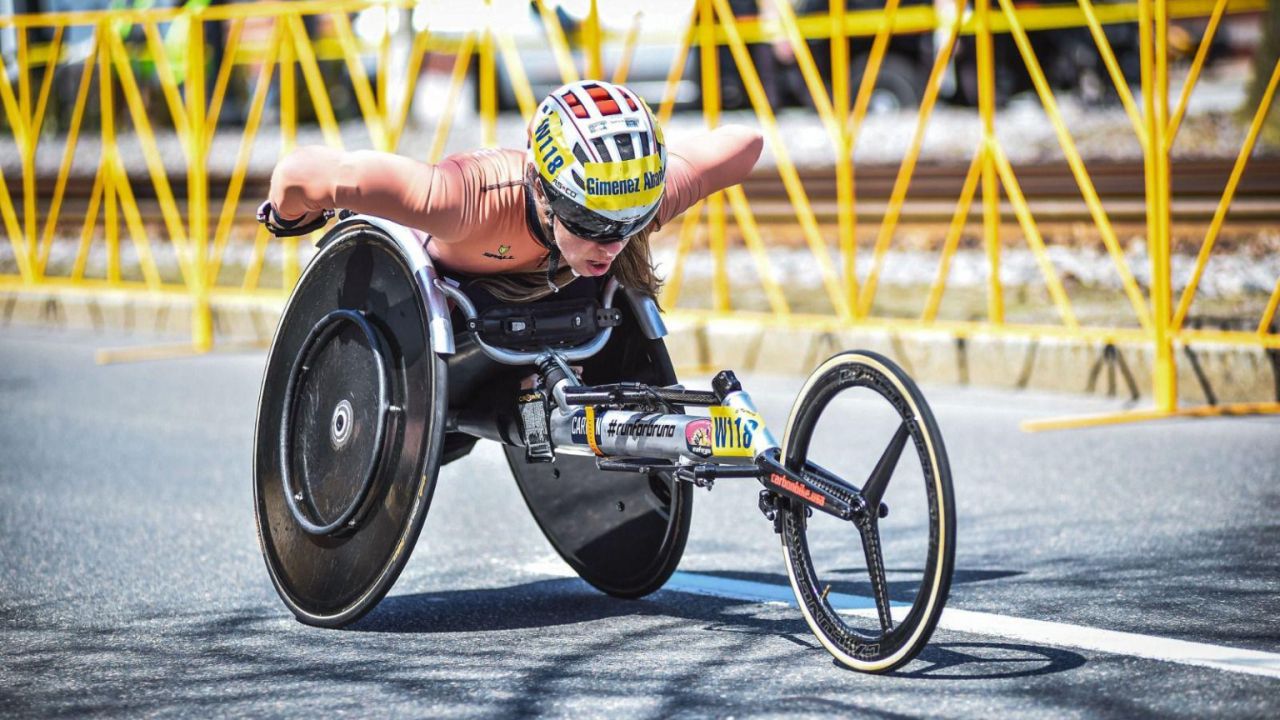
The Award Winner: Carmen Giménez Abad, whom nobody had heard of until then, but who, along with her remarkable achievement, will never be forgotten. Carmen is a Paralympic marathon runner who competes from her wheelchair; her greatest wish is that “in a few years’ time, her story will no longer be an exception, but will be commonplace and just one of many…”.
Carmen holds a degree in Business Administration and Management and in Actuarial and Financial Sciences from the Pontifical University of Comillas and was the first Spanish woman in a wheelchair to compete in the iconic marathons of Boston, Sydney, Berlin, Oita and South Africa – and not exactly because of the facilities available to her within Spain; she detailed the difficulties faced by a Paralympic athlete.
On the 26th, she will run the London Marathon, “where there is absolutely no difference between Paralympic and non-Paralympic athletes in terms of treatment, facilities, presentation, prize money,” said Carmen.
And there remained a difficult question – the kind a professional might hesitate to ask, the kind that can invade a person’s privacy. We tend to associate paraplegia with road traffic accidents; sadly, it is linked to a statistical fact, but that was not the case with Carmen.
And there remained a difficult question – the kind a professional might hesitate to ask, the kind that can invade a person’s privacy. We tend to associate paraplegia with road traffic accidents; sadly, it is linked to a statistical fact, but that was not the case with Carmen.
They say that love conquers all, and it can even cut a life short. Carmen, without any hint of resentment or hatred, neither in words nor gestures, but rather with pity for that ill-bred ‘man’ who, in March 2010, threw Carmen from a third-floor window.
A long stay at the paraplegic hospital in Toledo, considered one of the best in Europe, made Carmen fight to live and decide that “walking was just a verb, and in life there are many verbs and goals to achieve”.
On leaving the hospital, she took up athletics, going on to become Spanish champion in the 800m, 1500m and 5000m flat races. But this time it was not a verb but a noun linked to an adjective: “destiny”.
In 2018, her second son, Bruno, was born prematurely. A few hours after his birth, Bruno passed away, but his life clung to his mother’s heart, where it continues to beat. It is the source, the life force from which all the energy flows, leading Carmen to decide to dedicate her life to wheelchair athletics.
In 2020, Carmen founded the RUN FOR YOU Project, a project comprising the BRUNO Athletics Club and the RUN FOR YOU Foundation.
To conclude, let us say to Carmen’s three children—Ana, Bruno and Valentina—that when Pheidippides shouted “Nike”, the image of their mother bathed Athens.
We’ll be able to see Carmen at the London Marathon, which starts in Greenwich Park/Blackheath, crosses Tower Bridge, winds its way through the East End and Canary Wharf, and finishes on The Mall, opposite Buckingham Palace, after passing the London Eye and Big Ben.